Ecinq®: Understanding Ulipristal Acetate in Emergency Contraception
Pharmacist Education
Ecinq®: Understanding Ulipristal Acetate in Emergency Contraception
Think ovulation — not only hours.
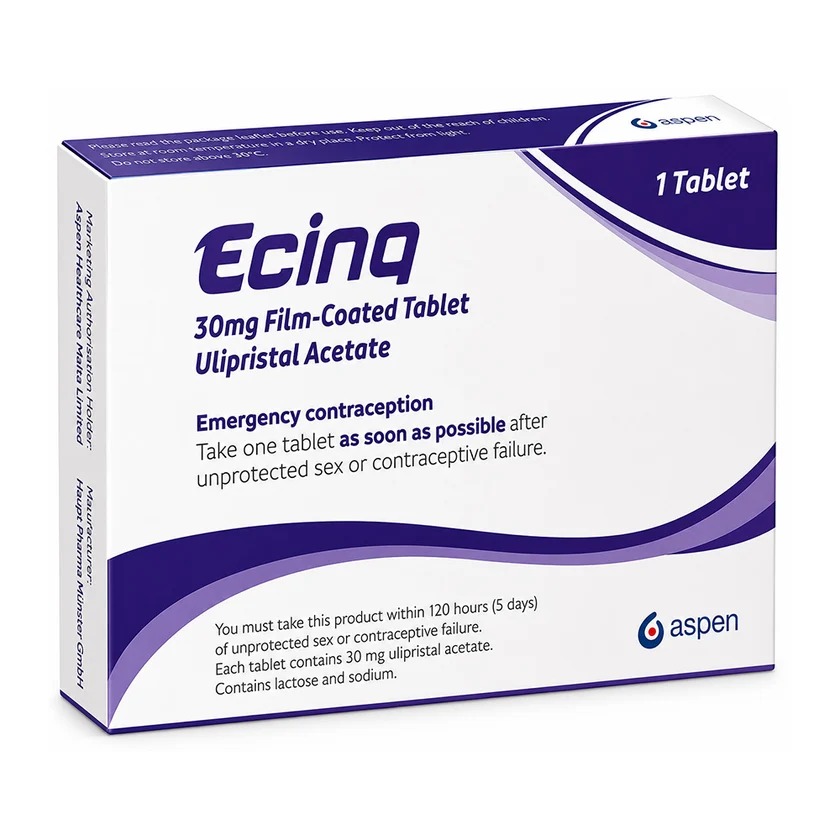
Ecinq® contains ulipristal acetate 30 mg and is indicated for emergency contraception within 120 hours (5 days) of unprotected sexual intercourse or contraceptive failure.
Emergency contraception is often reduced to one instruction: “Take the pill as soon as possible after unprotected intercourse.” While that advice is important, understanding why timing matters makes emergency contraception much easier to explain, recommend, and counsel on appropriately.
Start with the fertile window
Pregnancy does not necessarily occur immediately after intercourse. Sperm can remain viable in the female reproductive tract for up to approximately 5 days. This means intercourse several days before ovulation can still lead to fertilization if viable sperm remain present when the oocyte is released.
The probability of pregnancy increases as ovulation approaches and falls sharply after ovulation. Therefore, the clinically relevant fertile window is driven by two biological facts: sperm can survive for several days, while the oocyte remains fertilizable for only a short period after ovulation.
Core concept: If ovulation can be delayed long enough, viable sperm may no longer be present when the oocyte is eventually released.
What is Ecinq®?
Ecinq® contains ulipristal acetate 30 mg, supplied as one film-coated tablet. It is used for emergency contraception after unprotected sexual intercourse or contraceptive failure.
- Dose: one tablet only.
- Timing: take as soon as possible, but no later than 120 hours (5 days) after intercourse.
- Administration: can be taken at any time during the menstrual cycle, with or without food.
- If vomiting occurs within 3 hours of intake, another tablet should be taken.
Emergency contraception may be needed after intercourse without contraception, condom failure, incorrect use of regular contraception, or another situation in which contraceptive protection may have failed.
How does Ecinq® work?
Ulipristal acetate is a selective progesterone receptor modulator (SPRM). Its main mechanism as emergency contraception is delaying or inhibiting ovulation.
Progesterone-receptor signaling contributes to the final processes involved in follicular rupture. By modulating progesterone receptors, ulipristal acetate can delay follicular rupture and therefore postpone ovulation.
Why is ulipristal acetate different from levonorgestrel?
Both ulipristal acetate (UPA) and levonorgestrel (LNG) emergency contraception primarily aim to delay ovulation. The important difference is how late in the pre-ovulatory process they can still do so.
Levonorgestrel has a narrower effective window around the LH rise. In contrast, UPA has a more direct inhibitory effect on follicular rupture and may still delay ovulation when given shortly before ovulation — a stage at which LNG may no longer successfully delay follicular rupture.
| Clinical timing | Levonorgestrel (LNG) | Ulipristal acetate (UPA) |
|---|---|---|
| Earlier before ovulation | Can delay ovulation | Can delay ovulation |
| LH begins to rise / closer to ovulation | Effectiveness in delaying ovulation decreases | May still delay follicular rupture |
| After ovulation has occurred | Cannot reverse ovulation | Cannot reverse ovulation |
Pharmacist takeaway: Ecinq® is not simply “a stronger dose.” Its clinical advantage is that UPA can act later in the pre-ovulatory process than LNG.
Why does the 5-day window matter?
The 120-hour treatment window is closely related to the potential survival time of sperm in the female reproductive tract. This creates a simple way to remember the rationale:
Important: the 5-day window should never be interpreted as a reason to wait. Ecinq® should be taken as soon as possible after the event.
What does the evidence show?
The sponsor educational material summarizes comparative clinical evidence between UPA and LNG. In a randomized trial involving women who used emergency contraception within 72 hours of unprotected intercourse, pregnancy occurred in 1.8% of women receiving UPA compared with 2.6% of women receiving LNG.
The material also cites international guidance and professional organizations that recognize UPA as an important oral emergency-contraception option, particularly when presentation is later or intercourse may have occurred close to ovulation.
Key counseling points for pharmacists
- Take it early. Recommend one tablet as soon as possible after unprotected intercourse or contraceptive failure; the maximum window is 120 hours.
- It does not protect future intercourse. A further episode of unprotected intercourse later in the same cycle can still result in pregnancy.
- Do not combine with LNG emergency contraception. Concomitant use of ulipristal acetate and levonorgestrel-containing emergency contraception is not recommended.
- Check for interacting medicines. CYP3A4 enzyme inducers such as carbamazepine, phenytoin, rifampicin, and St. John’s wort can reduce ulipristal exposure and effectiveness.
- Vomiting matters. If vomiting occurs within 3 hours of taking Ecinq®, another tablet should be taken.
- Expect possible cycle changes. The next menstrual period may occur a few days earlier or later than expected.
- Know the common adverse effects. Headache, nausea, abdominal pain and dysmenorrhea are among the most commonly reported adverse effects.
- It is emergency contraception — not an abortion pill. Ulipristal acetate is not intended to interrupt an established pregnancy.
The pharmacist takeaway
When counseling on emergency contraception, do not think only: “How many hours have passed?” Also think: “Where might this patient be relative to ovulation?”
Because the exact day of ovulation is not usually known with certainty, UPA’s ability to act later in the pre-ovulatory process is one of its most clinically relevant characteristics.
Remember Ecinq® in five points
- Ulipristal acetate 30 mg
- One tablet
- Take as soon as possible
- Can be used up to 120 hours / 5 days after intercourse
- Delays ovulation and can remain effective closer to ovulation than LNG
References
- Ecinq® API / Full Product Information. Aspen Healthcare, updated August 2024.
- Gemzell-Danielsson K, Meng C. Emergency contraception: potential role of ulipristal acetate. Int J Womens Health. 2010;2:53–61.
- Glasier AF, et al. Ulipristal acetate versus levonorgestrel for emergency contraception: a randomised non-inferiority trial and meta-analysis. Lancet. 2010;375(9714):555–562.
- Glasier A, et al. Can we identify women at risk of pregnancy despite using emergency contraception? Contraception. 2011;84(4):363–367.
- World Health Organization. Emergency contraception / Selected practice recommendations for contraceptive use.
- FSRH Guideline: Emergency Contraception. March 2017; amended July 2023.
For educational use by healthcare professionals. Refer to the locally approved product information and applicable clinical guidance before recommending or dispensing.

You may also like